Worried about laser hair removal side effects? Here is the honest picture. When performed by a qualified dermatologist, the procedure is remarkably safe, and most reactions are mild and short-lived, slight redness, warmth, or puffiness that settles within hours. Serious complications like scarring or burns are rare and almost always linked to untrained operators or wrong laser settings. Claims about cancer, infertility, or organ damage have no scientific basis whatsoever. So, is laser hair removal safe? Yes, provided your skin type is assessed properly, the right technology is used, and you follow simple aftercare. The real risk is not the laser; it is choosing the wrong hands to operate it.
Understanding Laser Hair Removal Side Effects
Here is a familiar scene. Someone finally decides to book their first laser session after years of waxing pain. Then they make the mistake of searching online at midnight and suddenly they are reading horror stories about burnt skin, permanent scars, and worse. By morning, they had cancelled the appointment.
If that sounds like you or someone you know, this article is for you. Let us separate genuine medical facts from internet fiction, calmly and clearly.
Definition
Laser hair removal side effects are the skin reactions that can occur after a laser session. During treatment, the laser delivers light energy that is absorbed by the pigment in the hair and converted to heat, disabling the follicle. Because heat is involved, the surrounding skin can react temporarily — much like it does after a day in the sun. These reactions are the body’s normal response, not a sign that something has gone wrong.
Causes
Why do side effects happen at all? A few clear reasons:
- Heat response — the skin naturally reddens when follicles absorb laser energy
- Wrong laser for the skin tone — the most common cause of pigmentation issues
- Untrained operators — incorrect settings cause the majority of serious complications
- Poor aftercare — sun exposure or harsh products on freshly treated skin
- Pre-existing conditions — active infections or photosensitive skin increase risk
Notice something? Most causes are avoidable. The laser itself is rarely the villain; misuse of it is.
Types of Side Effects
Doctors group reactions into two clear categories.
Temporary side effects of laser hair removal (common, harmless, self-resolving):
- Redness after laser hair removal — appears within minutes, fades within hours to a day
- Mild swelling around follicles, often called perifollicular oedema — tiny goosebump-like puffiness
- Skin irritation after laser hair removal — a warm, tingling, sunburn-like feeling
- Slight dryness or itching for a day or two
Long-term side effects of laser hair removal (rare, usually preventable):
- Pigmentation after laser hair removal — darkening or lightening of treated skin, mostly seen when the wrong wavelength is used on deeper complexions
- Blistering or crusting from excessive energy settings
- Scarring — extremely rare, and almost exclusively linked to unqualified operators
- Paradoxical hypertrichosis — an unusual phenomenon where fine hair thickens in nearby areas, seen occasionally on facial zones
Who Is Affected?
Anyone can experience mild, temporary reactions — that is normal physiology. However, some people carry higher risk: those with deeper skin tones treated on unsuitable machines, patients on photosensitising medication, anyone with a fresh tan, and clients of unregulated salons where “technicians” learn on the job. This is exactly where dermatologist laser hair removal advice becomes invaluable. A specialist identifies your risk profile before the laser ever touches your skin.
Myth vs Reality: The Comparison Every Patient Deserves
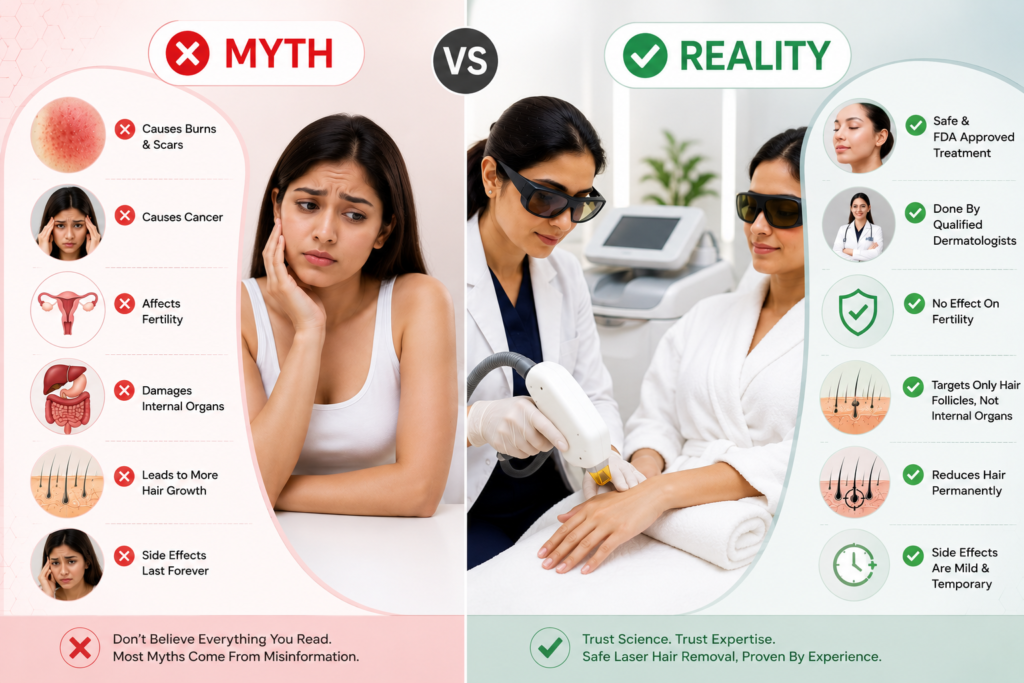
The internet is generous with fear and stingy with facts. This table sets the record straight on the most widespread laser hair removal myths:
| The Myth | The Reality |
| “Laser causes skin cancer” | The laser uses non-ionising light that does not alter DNA. No credible study links it to cancer. |
| “It damages internal organs” | The light penetrates only a few millimetres — just deep enough to reach follicles, nowhere near organs. |
| “It causes infertility” | Physically impossible; the energy never reaches beyond the skin layer, even in bikini-area treatments. |
| “Burnt skin is guaranteed” | Burns are rare and tied to wrong settings or fake machines — not to the procedure itself. |
| “It’s unsafe for Indian skin” | Nd:YAG and advanced diode lasers are specifically designed for medium and deeper complexions. |
| “The pain is unbearable” | Most patients describe a mild rubber-band snap; modern cooling systems make it gentler than waxing. |
| “Side effects last forever” | The overwhelming majority of reactions fade within 24–48 hours. |
Reading that table, one theme repeats: laser hair removal risks shrink dramatically when technology, expertise, and skin assessment come together. The horror stories almost always trace back to one missing ingredient — a qualified doctor.
Results & Recovery Timeline
Sessions Needed
Most patients need 6–8 sessions spaced 4–6 weeks apart, since the laser only disables follicles in their active growth phase. Hormone-sensitive areas like the chin may need a few more. Importantly, side effect risk does not accumulate with sessions — each visit carries the same low, well-managed risk.
Downtime
Practically zero. Expect the treated area to look slightly flushed for a few hours — comparable to a brisk walk on a warm afternoon. Most patients return to work immediately. What you should avoid for 24–48 hours: hot showers, gyms, saunas, swimming pools, and direct sunlight.
Expected Improvement
- Within hours: Redness and warmth settle
- Within 1–2 days: Any skin irritation after laser hair removal disappears completely
- After 2–3 sessions: Hair regrows finer and slower
- After 6–8 sessions: 80–95% reduction, with skin smoother than any razor ever achieved
And here is a lovely bonus many patients discover — ingrown hairs and razor bumps vanish, so the skin often looks better after laser than before it.
Safety & Who Should Avoid It
Laser hair removal safety rests on three pillars: correct diagnosis of your skin type, the right laser wavelength, and disciplined aftercare. When all three are present, complication rates drop to a fraction of a percent.
Managing Side Effects: The Role of Aftercare
Good laser hair removal aftercare is simple but non-negotiable:
- Apply the soothing gel or moisturiser your clinic recommends
- Use broad-spectrum sunscreen daily — this single habit prevents most pigmentation after laser hair removal
- Skip exfoliants, scrubs, and retinol for 3–5 days
- Avoid waxing or plucking between sessions (shaving is fine)
- Report anything unusual to your dermatologist promptly — early attention resolves nearly everything
Contraindications: Who Should Postpone or Avoid Treatment
- Pregnant women, purely as a precaution
- Patients on isotretinoin or other photosensitising medicines
- Anyone with active infections, open wounds, or a recent tan on the area
- People with a history of keloid scarring or conditions like vitiligo, pending medical evaluation
- Those with white or grey hair, since the laser needs pigment to work
A genuine dermatologist will screen for every one of these before treatment. If a clinic does not ask about your medications and medical history, walk out — that is the biggest red flag in this entire field.
Frequently Asked Questions
1. Is laser hair removal safe for the face?
Yes. Facial treatments are among the most commonly performed procedures worldwide. The eyes are shielded with protective goggles, and energy levels are calibrated for delicate skin. So if you have been wondering, “is laser hair removal safe for my upper lip or chin?” — the answer, under medical supervision, is a confident yes.
2. How long does redness after laser hair removal last?
Typically a few hours, occasionally up to a day. Redness after laser hair removal is the most common reaction and fades on its own — a cool compress speeds things along.
3. Are there any proven long-term side effects of laser hair removal?
Decades of clinical use show no systemic long-term harm. The rare long-term side effects of laser hair removal, such as pigment changes, are linked to improper technique — not to the technology itself and are largely preventable with correct laser selection.
4. What are the biggest laser hair removal risks I should actually worry about?
Honestly? Choosing an unqualified provider. Burns, blisters, and pigment problems almost always come from untrained hands or counterfeit machines. The procedure itself, done correctly, carries minimal laser hair removal risks.
5. Which laser hair removal myths should I stop believing today?
The cancer myth, the infertility myth, and the organ-damage myth — all three have zero scientific support. These laser hair removal myths survive on social media, not in medical journals.
6. What aftercare mistakes cause the most problems?
Sunbathing on freshly treated skin tops the list, followed by hot workouts and harsh scrubs. Following your clinic’s laser hair removal aftercare sheet for just 48 hours prevents nearly every avoidable reaction.
7. Should I consult a dermatologist even for a small area?
Absolutely. The most important dermatologist laser hair removal advice applies to every area, big or small: your skin must be assessed on the Fitzpatrick scale, and the machine must match your complexion. A small area does not mean small stakes.
About the Doctor
Behind every safe laser session is medical judgment — and at Cleo Skin Clinic, that judgment belongs to Dr. Vani Veggalam.
- Qualifications: MD in Dermatology, Venereology & Leprosy (MD-DVL); State Topper in the Diploma in Anesthesiology (DA); graduated with distinctions from NTR University of Health Sciences
- Experience: Over two decades as a Consultant Dermatologist and Laser Surgeon; Founder and Managing Director of Cleo Skin Clinic, serving patients since 2016
- Clinic Location: Flat No. 13, 2nd Floor, Road No. 1, Opposite GHMC Park, Kukatpally, Hyderabad
- Expertise and Recognition: Fellow of the American Academy of Aesthetic Medicine; member of IADVL and the Association of Cutaneous Surgeons of India; international speaker at Dubai Derma and Dermacon; recipient of the Best Dermatologist Award (Hi9, 2022) and the HMTV Healthcare Award (2023)
Her approach to laser hair removal safety is straightforward: assess first, treat second, and never compromise on technology suited to Indian skin.
Conclusion
So, what is the final word on laser hair removal side effects? The genuine ones are mild, brief, and manageable. A little redness, a little warmth, gone by tomorrow. The frightening ones circulating online are either myths with no scientific footing or complications born from unqualified providers. The lesson is not to fear the laser; it is to respect the choice of who operates it. Pick a dermatologist-led clinic, follow the aftercare, and the only lasting effect you will notice is beautifully smooth skin and the quiet joy of never booking another waxing appointment.
Related Reading and Treatments
Related treatment pages:
From our blog:
- Is Laser Hair Removal Permanent? (link your previously published post here)
- More skincare insights on the Cleo Skin Clinic Blog
Book Your Consultation
Still weighing the myths against the facts? Get answers specific to your skin. Book a consultation with Dr. Vani Veggalam at Cleo Skin Clinic, Kukatpally, and receive honest dermatologist laser hair removal advice before you commit to anything.
Book Your Consultation Now | Call: +91 96669 20777 / +91 95500 05777
Open 9 AM – 10 PM, Monday to Saturday.