You finally won the battle against breakouts. The pimples are gone. But every morning, the mirror still shows the marks they left behind — little pits, dents, and shadows that makeup can hide but never truly erase. Sound familiar? You’re not alone, and here’s the good news: those marks are treatable. Let’s talk about the best treatment for acne scars and settle the big question — laser or microneedling?
The best treatment for acne scars depends on your scar type and skin tone. Laser resurfacing works faster on deep, stubborn scars and usually needs 3–5 sessions, but carries a higher risk of pigmentation on Indian skin. Microneedling (especially RF microneedling) is gentler, safer for darker skin tones, and needs 4–6 sessions with minimal downtime. Many patients get the best results from a combination plan. A dermatologist will examine your scars — boxcar, ice pick, or rolling and recommend the right mix. Most people see 50–80% improvement within 3–6 months of starting treatment.
What Are Acne Scars, Really?
Think of your skin as a smooth bedsheet. When acne inflammation goes deep, it damages the collagen underneath — the “mattress” holding that sheet up. As the skin heals, it either produces too little collagen (creating a dent) or too much (creating a raised bump). That uneven repair job is what we call an acne scar.
Causes
- Deep, inflamed pimples (cysts and nodules) that injure the skin’s lower layers
- Picking, squeezing, or popping breakouts — we’ve all done it, and our skin remembers
- Delayed acne care, which lets inflammation linger longer
- Genetics — some skin simply scars more easily
Types of Acne Scars
| Scar Type | What It Looks Like | How Common |
| Ice pick | Narrow, deep holes — like a tiny needle poked the skin | Very common |
| Boxcar | Broad dents with sharp edges, like chickenpox marks | Common |
| Rolling | Wavy, uneven texture that shows in side lighting | Common |
| Hypertrophic | Raised, thick bumps above the skin | Less common |
| Post-inflammatory marks | Flat brown or red spots (technically not scars) | Extremely common |
Who Is Affected?
Acne scars are far more common than you’d think. Studies on over 24,000 people show that almost half of all acne sufferers get some scarring. That’s nearly 1 out of every 2 people. And it’s not just severe acne — even mild pimples can leave marks. Teenagers and young adults get scars the most, but it can happen at any age. Family history matters too. If your parents had acne, your chances of scarring go up a lot.
Treatment Options: Laser vs Microneedling
Here’s where the real conversation begins. These are the two most trusted acne scar treatment options recommended by dermatologists worldwide — and each works differently.
Laser Treatment for Acne Scars — Benefits and Risks
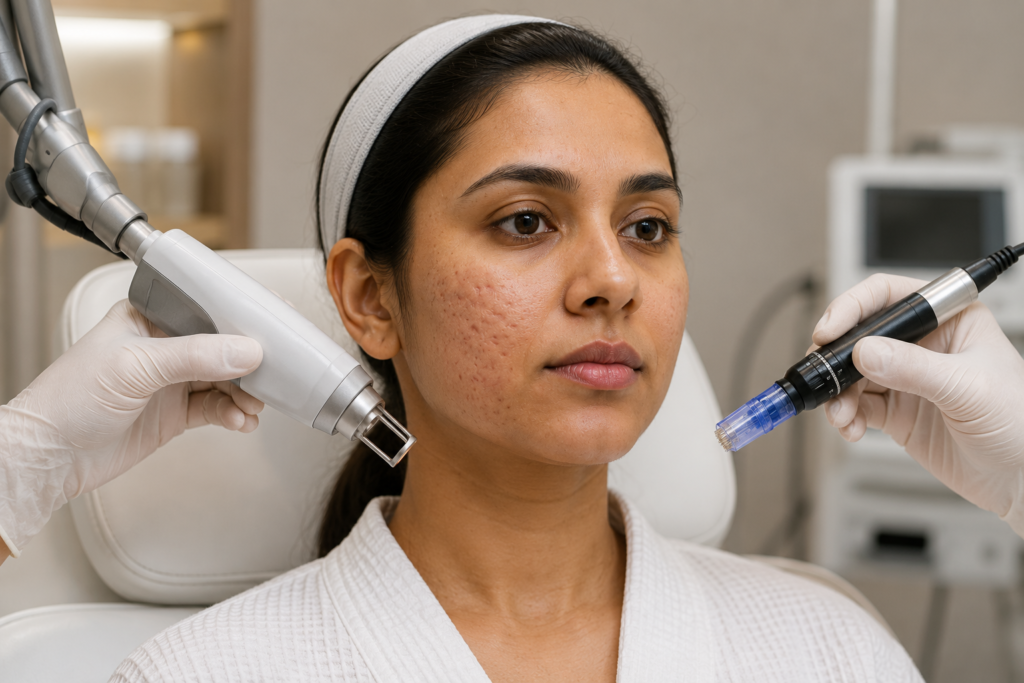
A fractional laser (like CO2 or Erbium) sends tiny beams of light into the skin. Each beam makes a very small, controlled injury — so small you can’t see it. Your skin then rushes to heal these spots. While healing, it builds fresh collagen. This new collagen fills up the scars from inside, and the skin slowly becomes smoother.
Think of it like re-plastering a wall with small holes. The laser tells your skin exactly where to do the repair work.
Benefits:
- Fast, dramatic results for deep boxcar and ice pick scars
- Also improves skin tone, pores, and fine lines in the same sitting
- Fewer sessions needed compared to most other methods
Risks:
- Redness and peeling for 5–7 days
- Higher chance of dark patches (pigmentation) on Indian and other medium-to-deep skin tones
- Needs strict sun protection afterwards
So that is the full picture of laser treatment for acne scars — benefits and risks. In simple words, it gives strong results, but only when done by a trained doctor who knows how to use it safely on your skin type.
Microneedling for Acne Scars — How It Works
In this treatment, a small device with very fine needles is moved over your skin. The needles make tiny holes that you cannot see. Your body sees these tiny holes as small wounds and starts healing them. During healing, it makes new collagen — the protein that keeps skin firm and smooth. Slowly, over a few weeks, this new collagen fills the scars from below. That is microneedling for acne scars — how it works in simple terms.
RF (radiofrequency) microneedling is an upgraded version. Along with the needles, it sends mild heat deep into the skin. This heat pushes the skin to make even more collagen. And because the heat goes below the surface, the top layer of skin stays safe — which is why it works so well for darker skin tones.
Benefits: minimal downtime, very low pigmentation risk, suitable for almost every skin type. Limitations: results build gradually, and very deep scars may still need a laser boost.
Fractional Laser vs RF Microneedling for Acne Scars — Comparison Table
| Feature | Fractional Laser | RF Microneedling |
| Best for | Deep boxcar & ice pick scars | Rolling scars, sensitive & darker skin |
| Sessions needed | 3–5 | 4–6 |
| Downtime | 5–7 days | 1–2 days |
| Pigmentation risk (Indian skin) | Moderate | Low |
| Pain level | Moderate (numbing cream used) | Mild to moderate |
| Cost per session | Higher | Moderate |
| Result speed | Faster | Gradual but steady |
When people ask about fractional laser vs RF microneedling for acne scars, the honest answer is: you often don’t have to pick just one. Many dermatologists use both — laser for the deep scars, and RF microneedling to smooth the overall skin texture. Together, they give better results than either one alone.
How to Choose the Right Acne Scar Treatment for Your Skin Type
Wondering how to choose the right acne scar treatment for your skin type? Keep it simple:
- Fair to wheatish skin + deep scars → fractional laser often wins
- Dusky or deep skin tones → RF microneedling is the safer starting point
- Mixed scar types → a combination plan gives the fullest correction
- Active acne still present → treat the acne first, scars second
Never self-diagnose from Instagram reels. Your skin deserves a proper, in-person assessment.
Results & Recovery Timeline
Let’s talk about acne scar removal: recovery time and results — because knowing what to expect keeps you patient and positive.
Sessions Needed
- Laser: 3–5 sessions, spaced 4–6 weeks apart
- Microneedling / RF microneedling: 4–6 sessions, spaced 4 weeks apart
Downtime
- Laser: expect a sunburn-like redness for 2–3 days, then light peeling till day 7. Work-from-home for a few days helps.
- Microneedling: pinkness for 24–48 hours. Many patients return to office the very next day.
Expected Improvement
Collagen is a slow builder — it keeps remodelling for up to 6 months after your last session. Here’s a realistic map of acne scar removal: recovery time and results:
- Month 1–2: skin feels smoother; small dents soften
- Month 3–4: visible filling of scars; friends start noticing
- Month 5–6: 50–80% overall improvement in most patients
One patient described it beautifully: “I stopped reaching for concealer without even realising it.” That’s the kind of quiet win these treatments deliver.
Safety & Who Should Avoid It
Both procedures are dermatologist-reviewed acne scar treatments with decades of clinical backing. Still, no procedure is for everyone.
Possible Side Effects
- Temporary redness, swelling, or mild burning sensation
- Tiny scabs or pinpoint dryness (microneedling)
- Pigmentation changes if sun protection is ignored (laser, mainly)
- Rare: infection or prolonged redness — almost always linked to unqualified providers
Who Should Avoid or Postpone Treatment
- Active, inflamed acne or skin infections in the treatment area
- Pregnancy or breastfeeding
- Keloid-prone skin (raised scarring tendency) — needs special evaluation
- Recent isotretinoin (acne medication) use — a waiting period may apply
- Uncontrolled diabetes or bleeding disorders
This is exactly why dermatologist-reviewed acne scar treatments should only be done at a proper clinic not a salon. The machine matters, but the hands and judgment behind it matter more.
FAQs
1. Which is the best treatment for acne scars — laser or microneedling?
Neither is universally superior. The best treatment for acne scars is the one matched to your scar type and skin tone. Deep scars respond faster to lasers; darker or sensitive skin does beautifully with RF microneedling. Both sit at the top of acne scar treatment options recommended by dermatologists, and combination plans often outperform either alone.
2. Is the procedure painful?
A numbing cream is applied 30–45 minutes before, so most patients feel only warmth or light prickling. On a scale of 10, people usually rate it a 3 or 4.
3. Can acne scars be removed 100%?
Honest answer: no clinic can promise 100%. But a 50–80% visible improvement is very achievable — enough that scars stop being the first thing you (or anyone else) notice.
4. How many sessions will I need?
Typically 3–5 laser sessions or 4–6 microneedling sessions, spaced a month apart. Older, deeper scars may need a few extra.
5. Is microneedling safe for dark Indian skin?
Yes, it’s one of the safest options for melanin-rich skin, with a very low pigmentation risk compared to aggressive lasers.
6. When can I wear makeup again?
After microneedling, usually within 24–48 hours. After laser resurfacing, wait about 5–7 days or until peeling settles.
7. Will the results be permanent?
The collagen you build is yours to keep. Treated scars don’t return, though new acne (if untreated) can create new ones — so maintaining clear skin matters.
About the Doctor
Dr. Vani Veggalam — Founder & Managing Director,Cleo Skin Clinic, Hyderabad
- Qualifications: MD in Dermatology, Venereology & Leprosy (MD–DVL) and Diploma in Anesthesiology — a state topper who graduated with distinctions from NTR University of Health Sciences
- Experience: Practising dermatology for over two decades, and running Cleo Skin Clinic’s success stories since 2016
- Clinic Location: Flat No: 13, 2nd Floor, Rd No 1, Opposite GHMC Park, Kukatpally, Hyderabad
- Expertise: Consultant Dermatologist & Laser Surgeon; Fellow of the American Academy of Aesthetic Medicine; member of IADVL, the Association of Cutaneous Surgeons of India, and the Cosmetic Dermatology Society of India; recipient of the Hi9 Best Dermatologist Award (2022) and HMTV Healthcare Award (2023); speaker at international forums including Dubai Derma and Dermacon
Conclusion
So, laser or microneedling? Here’s the friendly truth: the debate isn’t really laser versus microneedling — it’s about which tool (or which combination) suits your skin’s story. The best treatment for acne scars is personalised, planned, and performed by an expert who understands Indian skin. Your scars took years to form; give your skin a few months of smart treatment, and it will reward you with a smoothness you’d almost forgotten was possible.
Your skin has healed once before. With the right guidance, it can heal beautifully again.
Related Treatment Pages
More From Our Blog
📞 Ready to Say Goodbye to Acne Scars?
Stop guessing and start healing. Book a one-on-one consultation with Dr. Vani Veggalam at Cleo Skin Clinic, Kukatpally, and get a scar-treatment plan built just for you.
👉 Book Your Consultation Now | 📱 Call: +91 96669 20777 / +91 95500 05777
Open 9 AM – 10 PM, Monday to Saturday.