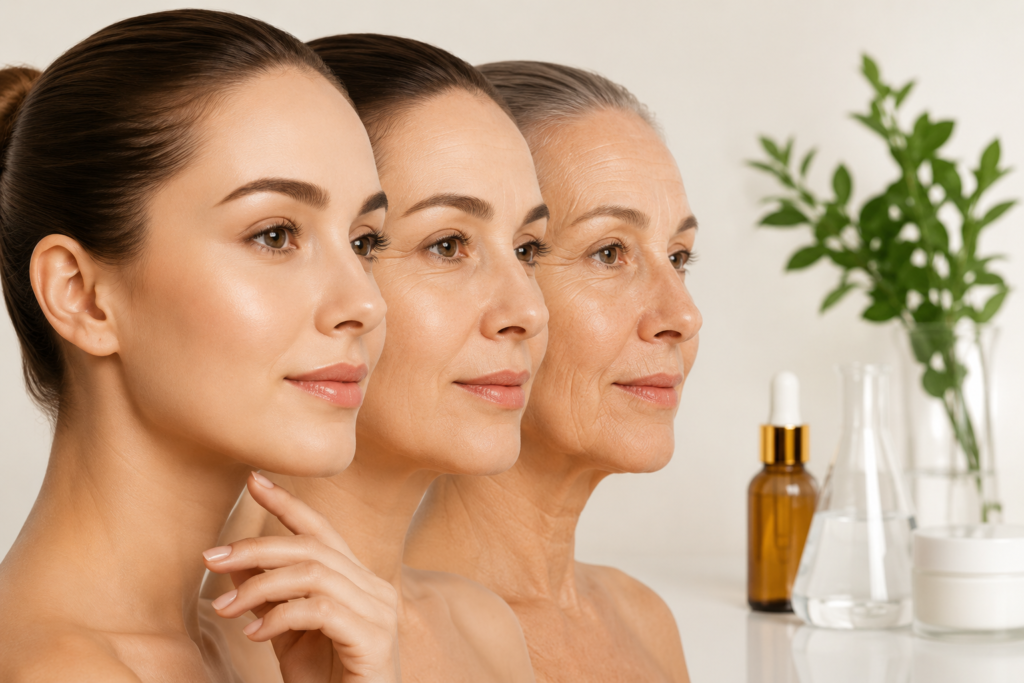
The best age to start anti aging treatments is between the late twenties and early thirties, when collagen levels begin to decline but visible wrinkles have not yet formed. At this stage, preventive anti aging treatments such as medi-facials, mild chemical peels and a structured anti aging skin care routine are usually sufficient. From the age of 35, a skin tightening treatment or collagen-stimulating laser helps maintain firmness. After 45, the clinical focus shifts from prevention to correction. For patients asking when should you start anti aging treatments, the established principle is to begin before visible damage develops rather than after.
What Is Skin Ageing?
Skin ageing is a structural change within the skin. Collagen and elastin are the two proteins responsible for firmness, smoothness and elasticity. From approximately the age of 25, the body produces around one percent less collagen each year. Because this decline is gradual, it produces no visible change in the early years, and most patients become aware of it only once the cumulative effect appears on the surface.
Clinically, skin ageing presents as thinning of the skin, fine lines, reduced radiance, uneven tone and a gradual loss of definition along the jawline.
What Causes Skin Ageing?
Skin ageing occurs through two distinct mechanisms.
1. Natural Aging
Natural aging is genetically determined. Collagen synthesis reduces each year, oil gland activity declines, cell turnover slows, and the skin gradually loses its capacity to recover its shape. This process affects everyone, although the rate varies between individuals.
2. Lifestyle Aging
Lifestyle aging results from external exposure and accounts for the majority of visible aging. Ultraviolet radiation is the leading cause, followed by pollution, inadequate sleep, high sugar intake, smoking and prolonged stress. In Hyderabad, where ultraviolet exposure remains high for most of the year, sun-related ageing frequently becomes visible almost a decade earlier than patients anticipate.
The extent of this damage is easily demonstrated. Skin on the inner forearm, which receives limited sun exposure, typically remains smoother and more even in tone than skin on the back of the hand on the same individual. The difference between the two sites reflects accumulated ultraviolet damage.
Types of Skin Aging You May Notice
- Fine lines and crow’s feet — usually the earliest sign
- Volume loss — hollowing beneath the eyes and flattening of the cheeks
- Laxity — reduced definition along the jawline and loosening of neck skin
- Pigmentation and dullness — uneven tone and a tired appearance
- Textural change — enlarged pores and rough patches
Who Is Affected
Skin ageing affects everyone, though it becomes visible earlier in certain groups.
Fair or naturally thin skin, a family history of early wrinkling, outdoor occupations, disturbed sleep and sustained stress all accelerate the process. Many women report a marked change around menopause, when declining hormone levels reduce skin hydration and elasticity over a relatively short period.
What Age Should You Start Anti Aging Treatments? An Age-Wise Guide
There is no single age at which every patient should begin treatment, and the question of what age should you start anti aging care is better answered by clinical assessment than by a birthday. For patients asking when should you start anti aging treatments, lifestyle, skin type and cumulative sun exposure are more reliable indicators than chronological age alone.
Twenties.
This is the appropriate stage for when to start anti-aging skincare. Daily broad-spectrum sunscreen, topical antioxidants and, where suitable, a low-strength retinoid are generally sufficient. The objective at this stage is protection rather than correction.
Thirties.
Collagen loss becomes measurable and early textural change appears. Early anti aging treatment is most effective here, typically light chemical peels, hydrating skin boosters and collagen-stimulating procedures introduced before laxity develops.
Forties.
Treatment shifts towards restoring volume and firmness. A skin aging treatment plan at this stage generally combines laser resurfacing, tightening devices and selective injectables.
Fifties and beyond.
Outcomes remain very good, though a greater number of sessions and a longer treatment period are required to achieve comparable improvement.
In clinical practice, the optimal anti aging treatment age generally falls several years before patients believe intervention is necessary. This is why the best age to start anti aging treatments is consistently earlier than most people assume.
Dermatologists frequently encounter patients who express regret at not seeking advice sooner. The reverse concern, that treatment was started too early, is rarely reported.
Treatment Options: What Works at Each Age
Selection of an appropriate anti ageing treatment is guided by clinical findings rather than age alone. The table below compares the most commonly recommended anti aging treatments for face, neck and jawline.
| Treatment | Ideal Age Range | What It Does | Sessions | Downtime |
|---|---|---|---|---|
| Medi-facials & Antioxidant Care | 22–30 | Hydration, radiance, damage protection | Monthly, ongoing | None |
| Chemical Peels | 25–45 | Smooths texture, fades pigmentation, refines pores | 4–6, monthly | 1–3 days of light peeling |
| Skin Boosters / Mesotherapy | 28–45 | Deep hydration, softens fine lines | 3 sessions, 4 weeks apart | Minimal |
| Microneedling with RF | 30–50 | Collagen remodelling, pore and scar refinement | 3–4 sessions | 2–3 days redness |
| Laser Skin Tightening Treatment | 35–60 | Firms lax skin, lifts jawline and neck | 3–6 sessions | Little to none |
| Botulinum Toxin | 28–60 | Relaxes expression lines | Every 4–6 months | None |
| Dermal Fillers | 35–65 | Restores lost volume and contour | 1 session, repeated yearly | 1–2 days swelling |
| Thread Lift | 40–60 | Non-surgical lift for moderate sagging | Single session | 3–7 days |
Most patients require only two or three of these procedures in combination. A planned, well-spaced anti ageing treatment protocol delivers more reliable long-term results than isolated or infrequent sessions.
Results and Recovery: What to Expect
Each skin aging treatment follows a defined clinical timeline, and understanding this timeline before treatment allows patients to plan appropriately.
How Many Sessions You Will Need
Non-invasive procedures work cumulatively rather than immediately. Chemical peels and microneedling generally require four to six sittings at intervals of three to four weeks. Laser tightening protocols typically involve three to six sessions. Injectable treatments produce visible results considerably sooner, usually within one week.
Downtime After Treatment
Recovery periods are short for most procedures performed in an outpatient setting.
- Medi-facials, skin boosters, botulinum toxin: same-day return to routine activity
- Chemical peels, laser tightening: mild redness for one to two days
- Microneedling with RF, thread lifts: three to seven days of settling
Expected Improvement Over Time
Weeks 1–2: improved hydration and surface radiance.
Weeks 4–8: refinement of texture and softening of fine lines.
Months 3–6: measurable collagen remodelling, with a visible improvement in firmness.
Collagen regeneration is a biological process rather than a cosmetic effect, and the final result therefore develops over several months.
Safety and Who Should Avoid Treatment
Possible Side Effects
These procedures carry a strong safety profile when performed by a qualified dermatologist, though temporary reactions are possible. These include mild redness, swelling, dryness and small bruises at injection sites. Post-inflammatory pigmentation is uncommon and is most often associated with inappropriate laser parameters on deeper skin tones, which is why device selection and clinical assessment are critical.
Who Should Wait or Avoid It
- Pregnancy and breastfeeding, for most energy-based and injectable procedures
- Active acne, eczema or infection at the treatment site
- A tendency to form keloid scars, for certain resurfacing procedures
- Isotretinoin use within the preceding six months
- Uncontrolled diabetes or autoimmune conditions, without medical clearance
- Patients whose expectations exceed what the procedure can achieve
Determining the correct anti aging treatment age requires a formal dermatological consultation and assessment of skin type, medical history and treatment goals.
Frequently Asked Questions
1. What is the best age to start anti aging skincare?
Between 22 and 25. Treatment begins with daily sunscreen, antioxidants and a low-strength retinoid. Dermatologists generally advise when to start anti aging skincare on the basis of sun exposure, recommending it as soon as daily exposure becomes routine. The best age to start anti aging skincare is therefore the age at which a consistent routine can be maintained.
2. Is 25 too early for professional treatments?
No. At this age, treatment is maintenance-based, involving hydrating facials and mild peels rather than corrective procedures. Preventive anti aging treatments at this stage are less expensive and produce better long-term outcomes.
3. Can treatment be started after 50 and still be effective?
Yes. Firming, resurfacing and volume restoration remain effective at any age, although a greater number of sessions and a longer treatment period are required.
4. Do these treatments thin the skin or create dependency?
No. Collagen-stimulating procedures increase dermal thickness over time. There is no dependency; if treatment is discontinued, the skin resumes its natural rate of ageing.
5. How should patients choose between skincare and clinical procedures?
Topical products act on the surface layers, while devices and injectables act within the deeper dermis. Optimal results are achieved by combining a structured anti aging skin care routine with appropriately timed clinical treatment.
6. At what age should men begin treatment?
The same timeline applies. Male skin is thicker and may age slightly later, although sun exposure and shaving-related irritation reduce this advantage.
7. Are these treatments suitable for sensitive skin?
In most cases, yes. Sensitivity influences the choice of technique and intensity rather than the achievable outcome.
About the Doctor
Dr. Vani Veggalam — Founder & Managing Director, Cleo Skin Clinic, Hyderabad
- Qualifications: MD in Dermatology, Venereology & Leprosy (MD–DVL) and Diploma in Anesthesiology — a state topper who graduated with distinctions from NTR University of Health Sciences
- Experience: Practising dermatology for over two decades, and running Cleo Skin Clinic’s success stories since 2016
- Clinic Location: Flat No: 13, 2nd Floor, Rd No 1, Opposite GHMC Park, Kukatpally, Hyderabad
- Expertise: Consultant Dermatologist & Laser Surgeon; Fellow of the American Academy of Aesthetic Medicine; member of IADVL, the Association of Cutaneous Surgeons of India, and the Cosmetic Dermatology Society of India; recipient of the Hi9 Best Dermatologist Award (2022) and HMTV Healthcare Award (2023); speaker at international forums including Dubai Derma and Dermacon
Conclusion: Start Early, Stay Consistent
Skin ageing is a gradual, predictable process, and it responds far better to early intervention than to delayed correction. Treatment undertaken at the right stage is preventive care in the same sense as routine dental or medical review.
The best age to start anti-aging treatments is the point at which prevention remains simpler and less expensive than correction, which for most patients is the late twenties. An early anti-aging treatment plan protects skin quality over the following decades and reduces the extent of intervention required later. Consistency, appropriate treatment selection and qualified medical supervision determine the outcome.
Related Treatments
Further Reading
Book a Consultation
Book a personal assessment with Dr. Vani Veggalam at Cleo Skin Clinic, Kukatpally, Hyderabad, and receive a treatment plan built around your hormone profile, your skin type, and your goals.
Phone: +91 96669 20777 | +91 95500 05777 Consulting hours: 9:00 AM – 10:00 PM, Monday to Saturday
This article is for general information and does not replace a personal medical consultation.