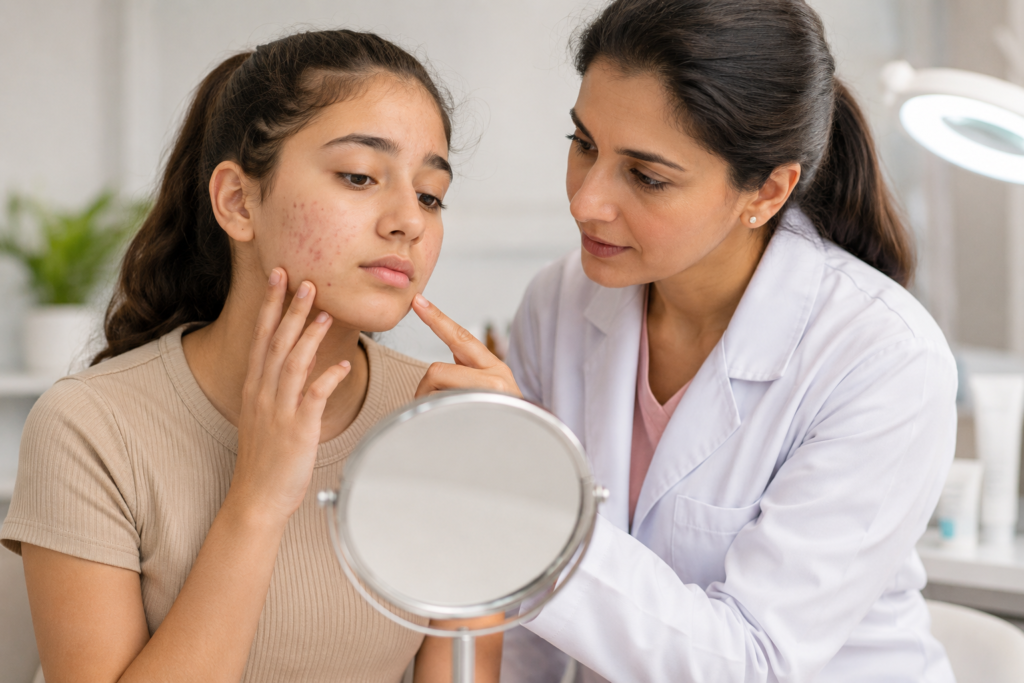
Acne is the most common skin problem of the teenage years. Nearly eight in ten teenagers develop it in some form, and for most families it raises the same three questions: Is this normal? When should a dermatologist be involved? Which treatments are genuinely safe at this age?
The answers matter more than most parents expect. Left untreated, breakouts can leave marks and scars that outlast the pimples themselves by years, and the window for preventing that damage is surprisingly short. Starting the right teenage acne treatment at the right time is therefore one of the more valuable decisions a parent can make during these years.
Most teenage breakouts respond well to a structured plan: a mild cleanser used twice daily, a dermatologist-prescribed topical such as a retinoid or benzoyl peroxide, daily sunscreen, and eight to twelve weeks of consistent use. Moderate or persistent cases benefit from in-clinic chemical peels and laser sessions, while deep, painful nodules may require oral medication under medical supervision. Effective acne treatment for teenagers always begins with a professional skin assessment rather than over-the-counter experimentation. Early intervention is critical, treating active breakouts promptly remains the most reliable way to prevent permanent scarring and pigmentation.
Each of these options makes far more sense once the cause is clear. Acne is not a hygiene problem, nor a phase to be waited out, it is a treatable medical condition with a well-understood mechanism.
Understanding Acne in Teenagers
Acne is a disorder of the oil glands attached to the hair follicles. During puberty, these glands enlarge and produce excess oil, known as sebum. When that oil mixes with dead skin cells, the follicle becomes blocked. Bacteria then multiply inside the sealed pore, and the body responds with inflammation — seen as redness, swelling, and pus.
In short, a pimple is a blocked pore that has become inflamed.
Causes
The principal factors behind acne in teenagers include:
- Hormonal changes — androgen (male hormone) levels rise sharply between the ages of 11 and 16 in both boys and girls
- Genetic predisposition — a strong family history significantly increases risk
- Friction and pressure — helmet straps, tight collars, mobile phone screens, and frequent face-touching
- Unsuitable products — pore-clogging creams, hair oil that spreads onto the forehead, and heavy sunscreens
- Stress and irregular sleep — examination periods frequently coincide with flare-ups
- Squeezing and picking — this turns a temporary bump into lasting damage
Diet has a smaller influence than commonly assumed, though very sugary foods and excess dairy may worsen existing breakouts in some teenagers.
Types
| Type | Clinical appearance | Severity |
| Comedones | Blackheads and whiteheads without inflammation | Mild |
| Papules | Small, tender red bumps | Mild to moderate |
| Pustules | Red lesions with a white or yellow centre | Moderate |
| Nodules | Deep, firm, painful lumps beneath the surface | Severe |
| Cysts | Large, soft, pus-filled swellings | Severe, high scarring risk |
Nodular and cystic lesions indicate severe acne in teenagers, and this stage requires dermatological management rather than home care.
Who Is Affected
Acne can begin as early as age nine and may persist into the mid-twenties. Teenage boys tend to develop deeper, inflamed lesions due to higher androgen activity; girls often notice flares linked to their menstrual cycle. Deeper skin tones carry an added risk: even mild lesions can leave dark marks that last for several months. Selecting an appropriate acne treatment for teenagers therefore depends on skin type as much as on lesion type.
Treatment Options
Dermatologists approach how to treat teenage acne in a defined order, escalating only when a milder measure has been given a fair trial. The established options, in that sequence, are as follows.
Topical Treatments
Topical therapy forms the foundation of almost every treatment plan. Retinoids unblock pores by speeding up skin-cell renewal, and benzoyl peroxide reduces acne-causing bacteria. Azelaic acid and niacinamide calm inflammation and lighten the marks left behind, while clindamycin gels treat active, inflamed lesions.
These agents remain the most cost-effective form of teen acne treatment when correctly matched to skin type and used consistently.
Chemical Peels
A superficial peel uses a controlled strength of salicylic, mandelic, or glycolic acid to dissolve pore blockages and lift away built-up surface cells. Salicylic acid suits oily, congested skin, while mandelic acid is preferred for deeper skin tones because it carries a lower risk of darkening.
Peels are typically introduced when topical therapy alone reaches a plateau, and they remain a core component of in-clinic teen acne treatment.
Laser and Light-Based Therapy
Modern lasers target overactive oil glands and the bacteria inside the follicle, while also reducing lingering redness and early scarring. Sessions are brief and well tolerated.
Parents evaluating the best acne treatment for teenagers often assume laser is the starting point. In practice, it is usually introduced once active inflammation is under control.
Oral Medication
When acne is deep and cystic, a dermatologist may prescribe oral antibiotics, hormonal therapy, or isotretinoin. These are effective but require medical monitoring and are never appropriate for self-medication. They are reserved for cases in which standard teenage pimples treatment has proved insufficient.
Combination Therapy
A single treatment usually controls acne, whereas a layered plan resolves it. A typical protocol combines a nightly topical, peels every three to four weeks, oral therapy where indicated, and laser once the inflammation has settled.
Among the teenage pimples best treatments, this combined approach consistently produces the most durable outcomes. It is also why no responsible clinic will name a single best treatment for teenage acne before examining the patient.
Comparing the Best Acne Treatments for Teens
The table below compares the main options and shows how the best treatment for teenage acne is chosen for an individual case.
| Treatment | Best suited for | Sessions required | Downtime | Tolerability |
| Topical therapy | Mild to moderate lesions | Daily, ongoing | None | Initial dryness |
| Chemical peels | Congestion, oiliness, dark marks | 4–6, every 3–4 weeks | 1–3 days light flaking | Mild tingling |
| Laser therapy | Deep lesions, redness, early scars | 4–8 sessions | A few hours of redness | Warm sensation |
| Oral medication | Deep, cystic, scarring acne | 3–6 months | None | Requires monitoring |
| Combination protocol | Persistent or relapsing cases | Individualised | Minimal | Well tolerated |
Results and Recovery Timeline
Understanding how to get rid of teenage acne also means understanding how long the process realistically takes.
| Stage | What to expect |
| Weeks 1–2 | Skin may look temporarily worse as retinoids bring underlying congestion to the surface |
| Weeks 3–6 | Fewer new lesions; existing ones resolve faster |
| Weeks 8–12 | Visible clearing — usually a 50–70% improvement in mild to moderate cases |
| Months 4–6 | Dark marks fade, texture evens out, and the maintenance phase begins |
Downtime is minimal across all in-clinic procedures. Peels produce one to two days of light flaking; laser leaves temporary pinkness for a few hours. School and sports attendance are rarely affected.
Scars are a separate matter. Once a pimple has left a permanent dent in the skin, creams and peels cannot lift it. That damage needs its own procedure, such as microneedling or fractional laser, and the work can only begin after the active breakouts have fully settled.
This is why starting teenager pimple treatment early is so important. Stopping a pimple from scarring is far easier, quicker, and cheaper than repairing a scar later.
Parents should also plan for the full course. Clearing acne takes three to six months of steady treatment, not a few weeks.
Safety and Who Should Avoid Treatment
Possible Side Effects
- Dryness, tightness, or mild peeling during the first two weeks
- Temporary redness following peels or laser sessions
- Greater sensitivity to sunlight, making daily sunscreen essential
- Brief stinging when active ingredients are applied
Contraindications
- Active eczema, cold sores (herpes simplex), or open wounds in the treatment area
- Recent sunburn or planned prolonged sun exposure
- Ongoing isotretinoin therapy for severe acne in teenagers, during which peels and lasers are usually postponed
- A documented history of keloid formation
- Pregnancy, in which retinoids are strictly prohibited
Acne creams should never be shared, as every person’s skin is different and the medicine is chosen to suit that person alone.
Preventive Care at Home
A structured teenage pimples treatment plan works best when supported by disciplined daily habits. For parents asking how to prevent pimples for teenagers, the essentials are straightforward:
- Cleanse twice daily with a gentle, non-foaming wash — avoid scrubbing
- Change pillowcases at least twice weekly
- Clean mobile screens regularly
- Keep hair oil away from the forehead and shampoo frequently
- Apply a light, non-clogging (non-comedogenic) sunscreen every morning
- Discourage picking and squeezing entirely
Consistency matters more than intensity. Frequent product-switching is one of the most common reasons treatment appears to fail, so these daily habits are the practical answer to how to prevent pimples for teenagers between clinic visits.
Frequently Asked Questions
1. At what age should a teenager see a dermatologist?
There is no minimum age for a consultation. Parents should book one as soon as the pimples turn painful, start leaving marks, or begin affecting their child’s confidence at school. Starting teenager pimple treatment early is the simplest way to avoid scars that would otherwise need correction later.
2. Are chemical peels safe for a 15-year-old?
Yes, provided a qualified dermatologist performs them and uses a mild solution suited to young skin. Gentle peels are one of the Best Acne Treatments for Teens and are used safely in clinics around the world every day.
3. Will acne clear up on its own after puberty?
In some teenagers it does settle without treatment. The problem is that nobody can predict who will clear up and who will scar, and by the time scars appear it is too late to prevent them. Waiting is a gamble, which is why doctors advise treating acne rather than sitting it out.
4. Do oily food and chocolate cause pimples?
Not directly. Hormones and family history play a far bigger role than diet. That said, a lot of sugar, cold drinks, and heavy dairy can make existing pimples flare up, so moderation helps even though food is rarely the root cause.
5. Is laser treatment safe for teenage skin?
Yes, as long as the dermatologist adjusts the machine to suit the child’s skin tone and the type of acne being treated. Laser is one of the teenage pimples best treatments for calming redness and smoothing scars that have just started to form.
6. How soon will we see a difference?
Most families notice a clear change by the eighth week. The skin keeps improving over the following months, and a full teenage acne treatment usually runs for three to six months from start to finish.
7. Does squeezing pimples really make things worse?
Yes, and this is one of the most common mistakes. Squeezing pushes the infection deeper into the skin and is a leading cause of permanent scarring. Any plan for how to treat teenage acne has to begin with breaking this habit.
About the Doctor
Dr. Vani Veggalam — Founder & Managing Director, Cleo Skin Clinic, Hyderabad
- Qualifications: MD in Dermatology, Venereology & Leprosy (MD–DVL) and Diploma in Anesthesiology — a state topper who graduated with distinctions from NTR University of Health Sciences
- Experience: Practising dermatology for over two decades, and running Cleo Skin Clinic’s success stories since 2016
- Clinic Location: Flat No: 13, 2nd Floor, Rd No 1, Opposite GHMC Park, Kukatpally, Hyderabad
- Expertise: Consultant Dermatologist & Laser Surgeon; Fellow of the American Academy of Aesthetic Medicine; member of IADVL, the Association of Cutaneous Surgeons of India, and the Cosmetic Dermatology Society of India; recipient of the Hi9 Best Dermatologist Award (2022) and HMTV Healthcare Award (2023); speaker at international forums including Dubai Derma and Dermacon
Conclusion
Teenage acne is a medical condition with proven, well-tested solutions. It is temporary; the scarring it leaves behind is not.
Parents researching how to get rid of teenage acne will encounter a considerable volume of conflicting advice online. Clinical assessment remains the reliable starting point.
The most effective acne treatment for teenagers is not the most expensive option, but the one selected after an accurate diagnosis and followed consistently. Where breakouts are painful, recurrent, or leaving marks, a dermatological consultation is the appropriate next step.
Related Treatments
Further Reading
Book a Consultation
Book a personal assessment with Dr. Vani Veggalam at Cleo Skin Clinic, Kukatpally, Hyderabad, and receive a treatment plan built around your hormone profile, your skin type, and your goals.
Phone: +91 96669 20777 | +91 95500 05777 Consulting hours: 9:00 AM – 10:00 PM, Monday to Saturday
This article is for general information and does not replace a personal medical consultation.