
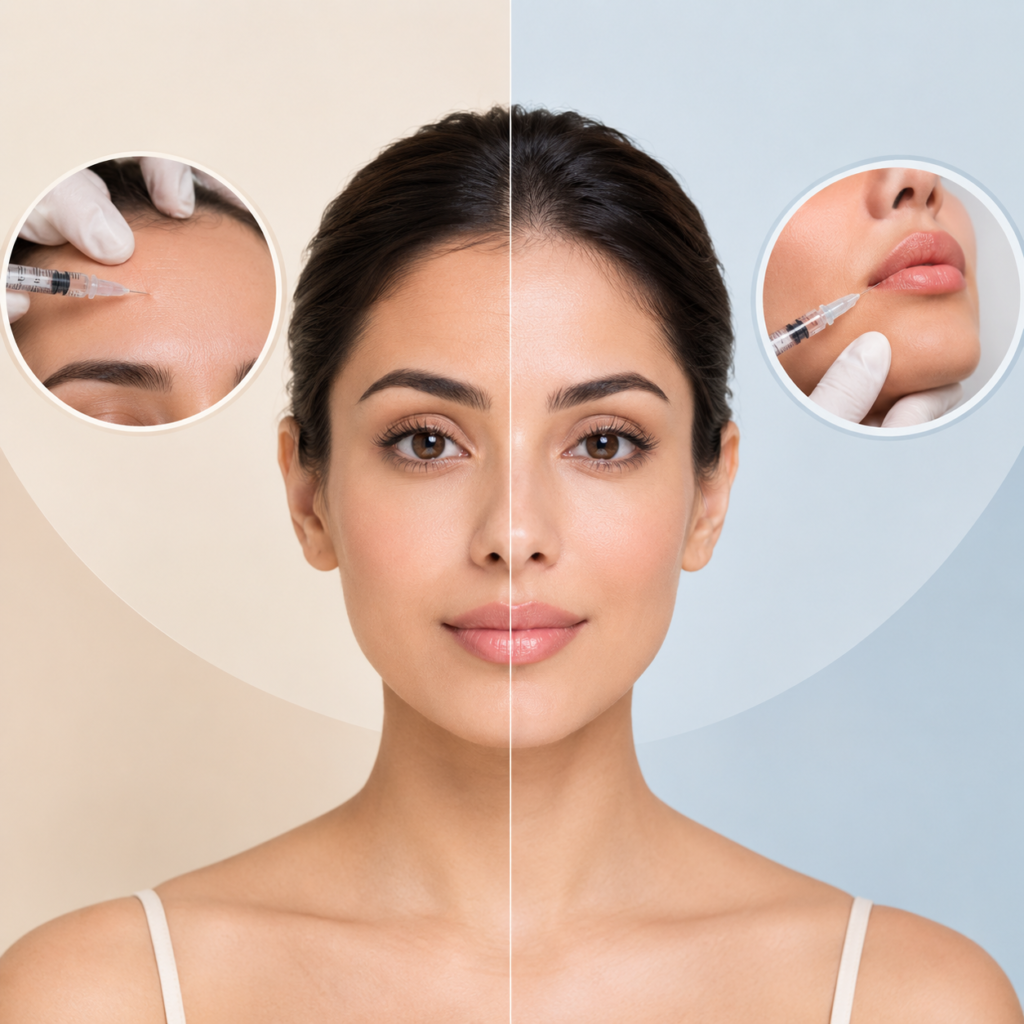
Wondering about the difference between Botox & fillers? Here’s the short version: Botox relaxes the muscles that cause movement wrinkles (think frown lines and crow’s feet), while fillers add volume to areas that have gone hollow or flat, like cheeks and lips. Neither is “better” — they simply solve different problems. Botox smooths lines caused by expression. Fillers restore lost fullness and structure. Many people actually need both for a balanced, natural result. This guide breaks down uses, costs, safety, and recovery, so you can walk into your consultation already knowing your options.
What’s Really Going On With Your Skin?
Nobody wakes up one morning to find a full set of wrinkles staring back at them. It happens quietly, over years, through thousands of ordinary moments — laughing at a joke, squinting at your phone screen in bright sunlight, frowning while stuck in traffic. Each of these small, repeated movements gradually etches a line into the skin above the muscle. On top of that, your skin is fighting a second, quieter battle in the background: as you age, it simply makes less collagen and elastin, the two proteins that once kept your face plump and bouncy. Throw in sun exposure, gravity, and a slower cell turnover, and you end up dealing with two very different kinds of aging at once — one caused by movement, the other by a loss of structure underneath.
This is actually the whole reason Botox and fillers exist as separate treatments. They’re not competing products fighting for the same job. They’re built to solve two completely different problems, and it starts with understanding what you’re actually looking at in the mirror.
Definition
Dermatologists usually describe this using two terms:
dynamic wrinkles, the ones that only show up when a muscle moves, think of the lines that appear the moment you smile or raise your eyebrows
static wrinkles, which stay visible even when your face is completely relaxed.
Dynamic lines tend to sneak in first, sometimes as early as your mid-twenties if you’re an expressive person. Static wrinkles and volume loss usually show up later, once the skin has lost enough collagen and fat padding that it can’t bounce back on its own anymore.
Causes
What actually causes all this? It’s rarely just one thing.
Repeated muscle movement is the main reason dynamic lines form in the first place, the more animated your expressions, the earlier they tend to appear. Beyond that, a few other factors usually pile up together:
- Declining collagen and elastin production as you age
- Years of sun exposure quietly breaking down the collagen you already have
- Smoking, which speeds up skin ageing considerably
- Poor sleep and dehydration
- Pollution and environmental stress
- Genetics, which decides a lot about timing
- Shifting bone structure under the skin, which subtly changes your facial framework over time
None of this happens overnight, which is exactly why most people don’t notice it creeping in until it’s already fairly visible.
Types
Now, when it comes to treatment, it helps to know that not all Botox and not all fillers are the same product.
Types of Botox (Neuromodulators)
- Botox (onabotulinumtoxinA) – the original, FDA-approved and most researched option, often used as the benchmark for newer neuromodulators
- Dysport (abobotulinumtoxinA) – tends to spread slightly more, often preferred for larger areas like the forehead
- Xeomin (incobotulinumtoxinA) – a “purer” formulation without additive proteins, sometimes chosen for those sensitive to other brands
All three work the same basic way, relaxing targeted facial muscles but differ slightly in dosing units, onset time, and how far they spread once injected.
Types of Dermal Fillers
- Hyaluronic acid fillers – the most commonly used, since hyaluronic acid already occurs naturally in your skin, and results can even be reversed if needed
- Calcium hydroxylapatite fillers – thicker in consistency, often chosen for deeper structural support, like along the jawline or cheekbones
- Poly-L-lactic acid fillers – work gradually by encouraging your own body to produce more collagen over several sessions
Who Is Affected
So who actually deals with all this? Pretty much everyone, eventually. Genetics decides a lot about when it starts and how visible it becomes, but lifestyle habits like sun exposure, smoking, stress, even how consistent your skincare routine is. Most people first notice dynamic lines somewhere in their late twenties to early thirties, while volume loss and static wrinkles tend to become more obvious through the late thirties and forties. But there’s no fixed rulebook here. Some people in their fifties still have remarkably smooth skin, and others notice changes much earlier which is exactly why a proper, personalised assessment matters far more than going by age alone.
Botox and Fillers Difference: Breaking It Down
This is the part everyone gets confused about, so let’s clear the fog.
Botox is a purified protein that temporarily blocks nerve signals to targeted muscles. When a muscle can’t contract as forcefully, the skin above it stays smoother. It’s brilliant for expression lines — the ones that show up when you smile, squint, or raise your eyebrows.
Dermal fillers, meanwhile, are gel-like substances (most commonly hyaluronic acid) injected beneath the skin to add volume, lift sagging areas, and plump up lips or cheeks. They don’t touch muscle movement at all — they physically fill in space that’s been lost.
So when people ask if Botox is better than fillers, the honest answer is: it depends entirely on what you’re trying to fix. A Botox treatment for face wrinkles caused by muscle movement won’t do a thing for hollow cheeks, and fillers won’t stop your forehead from creasing when you’re surprised.
Treatment Options Compared
| Feature | Botox | Dermal Fillers |
| Main purpose | Relaxes muscles to reduce movement lines | Adds volume and restores facial contours |
| Best for | Forehead lines, frown lines, crow’s feet | Cheeks, lips, nasolabial folds, jawline |
| How it works | Blocks nerve signals to muscles | Physically fills space under the skin |
| Onset of results | 3–7 days | Immediate |
| Duration | 3–4 months | 6–18 months (varies by product) |
| Downtime | Minimal, almost none | Minimal, mild swelling possible |
| Sensation | Quick pinch, no anaesthesia usually needed | Numbing cream often used first |
When people search Botox vs dermal fillers, this table is essentially the cheat sheet they’re looking for. Both are non-surgical, both use fine needles, and both can be done during a lunch break.
Results & Recovery Timeline
Here’s where patience matters, because Botox vs fillers results don’t show up on the same schedule.
Sessions needed: Most people need just one session to see a noticeable change with either treatment. Botox may need a touch-up two weeks later if the effect isn’t fully even. Fillers rarely need more than one sitting per area.
Downtime: This is genuinely one of the best parts. There’s no bandage-wrapped recovery period here. You might see slight redness or a small bump at the injection site, but most people go straight back to work, errands, or dinner plans the same day.
Expected improvement: With Botox, give it a week before judging the result — the muscle needs time to fully relax. Fillers, though, show change almost instantly, which honestly feels a little magical the first time you see it in the mirror.
Think of it like this: Botox is a slow fade of tension, while fillers are an immediate sculpt.
Safety & Who Should Avoid It
Both treatments have decades of research behind them and strong safety records when performed by a qualified professional. But let’s talk honestly about the risks, because informed decisions are always the best ones.
Side effects and risks of Botox can include mild bruising, a temporary headache, or slight drooping of the eyebrow or eyelid if the injection isn’t placed with precision. These effects are uncommon and usually fade within days.
Side effects and risks of fillers may include swelling, tenderness, or small lumps under the skin. Rarely, if a filler is injected too close to a blood vessel, it can cause more serious complications which is exactly why choosing an experienced injector matters more than chasing the cheapest deal.
Who should avoid these treatments:
- Pregnant or breastfeeding individuals
- People with active skin infections near the treatment area
- Those with certain neuromuscular disorders (for Botox specifically)
- Anyone with a known allergy to the injected substance
If you’re asking which is safer, Botox or fillers, both are considered low-risk when administered correctly. The real safety factor isn’t the product — it’s the hands holding the syringe.
How Much Do Botox and Fillers Cost?
This is usually the million-rupee question, quite literally. How much do Botox and fillers cost varies based on the area treated, the number of units or syringes used, and the product brand. Botox is typically priced per unit, while fillers are priced per syringe (1ml being standard). Rather than comparing sticker prices, it’s smarter to think about cost per month of visible results, since fillers tend to last significantly longer than Botox.
For an accurate, personalised quote, a consultation is honestly your best move — every face has different needs.
Botox or Fillers: Which Is Right for You?
Still torn on Botox or fillers which is better for your specific concern? Here’s a simple way to decide:
- Bothered by lines that only appear when you smile or frown? Botox is your answer.
- Noticing hollow cheeks, thin lips, or a tired, sunken look? Fillers will serve you better.
- Want an overall refreshed look without looking “done”? A combination approach often gives the most natural, balanced result.
Choosing Botox or fillers which is right for me really comes down to your goals, your budget, and your face’s unique structure. A skilled dermatologist can map this out during your first visit.
Frequently Asked Questions
1. What is the main difference between Botox and fillers?
Botox relaxes muscles to soften movement-related wrinkles, while fillers add volume to restore lost fullness. They target completely different causes of ageing.
2. Is Botox better than fillers for wrinkles?
Not necessarily. Botox works best on dynamic lines caused by muscle movement, while fillers are better suited for static volume loss. The right choice depends on your specific concern.
3. How long do results from each treatment last?
Botox typically lasts three to four months, while fillers can last anywhere from six months to nearly two years, depending on the product used.
4. Which is safer, Botox or fillers?
Both are considered safe when performed by a trained, experienced professional. Complications are rare and usually minor when proper technique is followed.
5. Can I get Botox and fillers done together?
Yes, absolutely. Many patients combine both for a more complete, natural-looking rejuvenation, treating both muscle movement and volume loss in one visit.
6. Does the treatment hurt?
Most people describe it as a quick pinch rather than real pain. Numbing cream is often applied before filler treatments to keep things comfortable.
7. How soon will I see results?
Fillers show visible change almost immediately. Botox takes about three to seven days to show its full effect as the muscles gradually relax.
About the Doctor
Dr. Vani Veggalam — Founder & Managing Director, Cleo Skin Clinic, Hyderabad
- Qualifications: MD in Dermatology, Venereology & Leprosy (MD–DVL) and Diploma in Anesthesiology — a state topper who graduated with distinctions from NTR University of Health Sciences
- Experience: Practising dermatology for over two decades, and running Cleo Skin Clinic’s success stories since 2016
- Clinic Location: Flat No: 13, 2nd Floor, Rd No 1, Opposite GHMC Park, Kukatpally, Hyderabad
- Expertise: Consultant Dermatologist & Laser Surgeon; Fellow of the American Academy of Aesthetic Medicine; member of IADVL, the Association of Cutaneous Surgeons of India, and the Cosmetic Dermatology Society of India; recipient of the Hi9 Best Dermatologist Award (2022) and HMTV Healthcare Award (2023); speaker at international forums including Dubai Derma and Dermacon
Final Thoughts
At the end of the day, the difference between Botox & fillers isn’t about which one wins — it’s about which one matches what your face actually needs. Some people need to soften expression lines. Others need to bring back volume that time has quietly taken away. And plenty of people benefit from a thoughtful blend of both. The best Botox and fillers treatment is always the one that’s personalized to you, not a one-size-fits-all formula copied from someone else’s face.
If you’re still unsure where to start, that’s completely normal — this is exactly what a proper consultation is for.
Related Treatments
Further Reading
Ready to Take the Next Step?
Book a one-on-one consultation with Dr. Vani at Cleo Skin Clinic, Kukatpally, Hyderabad, and get a treatment plan built specifically around your face and your goals.
Call +91 96669 20777 or +91 95500 05777 to schedule your appointment today.