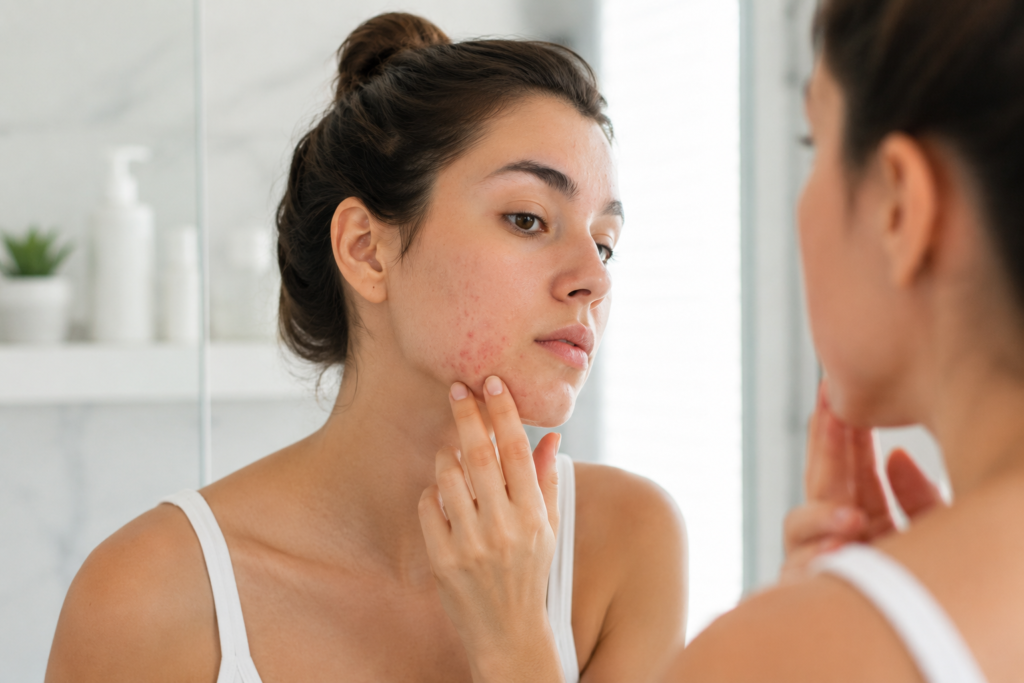
Adult acne has a way of catching people off guard. The skincare routine is consistent, the diet is reasonable, sleep is not the problem, and yet a firm, tender bump keeps returning to the same spot along the jawline, almost on schedule, month after month. It is tempting to blame the last indulgent meal or an unwashed pillowcase, but in most cases, neither is the real cause.
This recurring pattern has a name: hormonal acne. It is not a sign of poor hygiene or a failed diet. It is a hormonal issue, and treating it effectively starts with understanding what triggers it in the first place. This article covers the causes, the available treatment options, and a realistic recovery timeline to help make sense of a condition that can otherwise feel confusing and relentless.
Quick Answer Summary
Effective hormonal acne treatment rarely relies on a single product. It combines topical medication, such as retinoids or benzoyl peroxide, with hormone-regulating measures such as anti-androgens or birth control where medically appropriate, alongside adjustments to diet, stress levels, and daily skincare. Anyone researching how to treat hormonal acne that resurfaces around the jawline or chin should expect a dermatologist to begin with a full skin assessment, occasionally supported by hormone-level testing, before recommending a plan built around the individual’s cycle and skin type. Visible improvement typically appears within six to twelve weeks, with more complete results by the third or fourth month. Because these breakouts are cyclical by nature, treating them with unrelated over-the-counter products tends to produce inconsistent results. A structured, professionally guided plan works considerably faster.
What Is Hormonal Acne?
Hormonal acne refers to breakout activity driven primarily by fluctuations in androgens (hormones present in every body, though in varying amounts). When androgen levels shift, the skin’s oil glands respond by producing more sebum than usual. That excess oil clogs pores, allows bacteria to multiply, and leads to the inflammation that shows up as a breakout. Unlike the surface-level pimples common in adolescence, hormonal breakouts tend to sit deeper in the skin. They are often more painful, slower to resolve, and more likely to leave lingering marks.
What Causes It?
Because the trigger sits inside the body, identifying it is the real work of the first consultation. Several factors can be responsible, and in most patients more than one is acting at the same time, which is why a single-cause explanation seldom holds up. The most common hormonal acne causes are these:
- Higher androgen activity. Hormones such as testosterone enlarge the oil glands and thicken what they produce, so pores block far more easily.
- The monthly cycle. In the week before a period, hormone levels shift and the pore walls swell slightly, trapping oil that would otherwise drain.
- PCOS (Polycystic Ovary Syndrome). One of the leading hormonal acne causes in women between 20 and 40, usually alongside irregular periods and unwanted facial hair.
- Long-term stress. Sustained cortisol raises oil production and makes existing bumps redder, larger, and slower to settle.
- Pregnancy, the months after childbirth, and perimenopause. Each brings a genuine hormonal shift that the skin registers within weeks.
- Starting or stopping birth control. The adjustment period commonly produces a temporary but convincing flare.
- A diet high in sugar and refined carbohydrates. These raise insulin, which in turn nudges androgen levels upward.
Types of Breakouts
Identifying the cause explains why the skin is breaking out. The type of lesion present explains what the treatment then has to do about it, and the two together decide the plan.
| Type | What It Looks Like | How It Behaves |
| Blackheads and whiteheads | Small blocked pores | Not painful, but persistent |
| Papules | Small red bumps with no head | Tender to touch |
| Pustules | Red bumps with a white centre | Sore and inflamed |
| Nodules | Hard lumps deep under the skin | Painful, slow to clear |
| Cysts | Large, soft, swollen lesions | Very painful, high scarring risk |
Who Is Affected
Acne is typically associated with adolescence, yet hormonal acne treatment for adults has become an increasingly common clinical need, particularly among women in their twenties, thirties, and forties. Men experience it too, though the pattern is less predictable. For many adults who assumed clear skin was a fixture of the past, this resurgence can be genuinely disheartening. It is, however, also a well-understood and treatable condition.
Treatment Options for Hormonal Acne
The question of how to treat hormonal acne rarely has a single-product answer. A plan that lasts works in three stages: calm the inflammation on the surface, correct the hormonal trigger underneath, and finally repair any marks or scars left behind.
The order matters, especially in hormonal acne treatment for adults. Adult skin is thinner and drier than teenage skin and marks more easily, so strong drying products often make the situation worse rather than better.
Comparison of Treatment Options
| Treatment | How It Works | Best Suited For | Time to Results | Course Needed |
| Topical retinoids (adapalene, tretinoin) | Keeps pores clear by speeding up cell renewal | Mild to moderate acne | 8–12 weeks | Nightly, long-term |
| Benzoyl peroxide / azelaic acid | Reduces acne bacteria and redness | Inflamed bumps, dark marks | 4–8 weeks | Daily |
| Spironolactone (tablet) | Blocks the hormone signal reaching oil glands | Women with jawline acne, PCOS | 10–12 weeks | Ongoing, monitored |
| Combined oral contraceptives | Steadies monthly hormone swings | Cycle-linked flares | About 3 months | Prescribed long-term |
| Antibiotics (short course) | Settles sudden, severe inflammation | Acute flare-ups | 4–6 weeks | One course only |
| Chemical peels | Clear blocked pores and lighten marks | Blackheads, pigmentation | 2–3 weeks | 4–6 sessions |
| Laser and light therapy | Reduces oil gland activity | Acne that resists creams | 4–6 weeks | 4–8 sessions |
| Microneedling with radiofrequency | Rebuilds collagen in scarred areas | Pitted scars, uneven texture | 6–8 weeks | 3–6 sessions |
| Isotretinoin (tablet) | Shrinks oil glands for the long term | Severe, deep cystic acne | 8–16 weeks | 5–8 months |
Patients often ask which of these is the best treatment for hormonal acne. There is no universal winner. The best treatment for hormonal acne is the one matched to the hormone profile, the skin type, and the amount of scarring already present. Two people with the same number of bumps may need completely different plans.
Habits That Support the Results
Treatment does most of the work, but daily routine decides how quickly it shows.
- Wash the face twice a day with a mild cleanser, without scrubbing
- Moisturise even if the skin feels oily, using a non-comedogenic product
- Apply sunscreen every morning, as most acne treatments increase sun sensitivity
- Cut back on sugary drinks and refined carbohydrates
- Aim for seven to eight hours of sleep to keep stress hormones steady
- Avoid squeezing, which turns a two-week bump into a six-month mark
Results & Recovery Timeline
Sessions needed. Most in-clinic plans run to four to eight sittings, spaced two to four weeks apart, with creams or tablets continuing alongside for three to six months.
Downtime. Very little. Chemical peels cause light flaking for two to four days. Laser sessions leave mild redness that fades within a few hours. Microneedling needs about a day or two of rest. Most patients return to work the same day.
Expected improvement.
| Period | What Changes |
| Weeks 1–3 | Skin feels smoother; a short purging phase is possible |
| Weeks 4–6 | Fewer new bumps, less soreness |
| Weeks 8–12 | Roughly 50–70% fewer active breakouts |
| Months 4–6 | Dark marks fade, texture evens out, flares become rare |
A good hormonal acne treatment plan is judged by more than clearance alone. The real measure is how rarely the breakouts return.
Safety and Who Should Avoid It
Possible Side Effects
- Dryness, flaking, or mild stinging from retinoid creams
- A purging phase in the first three to four weeks, when things look briefly worse
- Increased sun sensitivity after peels and laser sessions
- Dizziness, breast tenderness, or changes in the cycle with spironolactone
- Temporary redness or darkening in deeper skin tones
When Treatment Should Be Avoided or Delayed
- Pregnancy and breastfeeding. Retinoids, isotretinoin, and spironolactone must not be used.
- Active skin infection, an eczema flare, or open wounds in the area being treated
- Skin that forms keloid scars, which needs a gentler, modified approach
- Recent isotretinoin use, where a six-month gap is advised before laser or peel work
- Uncontrolled diabetes or autoimmune conditions, without clearance from the treating physician
- Any known allergy to a peel ingredient or prescribed medicine
Prescription hormonal acne treatment should never be started on a friend’s recommendation or a social media video. A medicine that clears one person’s skin can inflame another’s.
Frequently Asked Questions
1. How can I tell whether my acne is hormonal?
Look at three things: the age it started, the location, and the timing. Adult-onset acne, deep and tender, sitting along the jaw and chin, and flaring at the same point each month, is almost always hormonal.
2. How to get rid of hormonal acne for good?
Long-term control is realistic; a permanent cure is not the way dermatologists frame it. How to get rid of hormonal acne durably comes down to treating the internal cause, keeping a simple daily routine, and returning for occasional maintenance sessions.
3. Does diet really make a difference?
It helps, but it does not cure. Reducing sugar, sweetened drinks, and excess dairy lowers how often flares occur for many patients, though it works best alongside medical treatment.
4. Is hormonal acne treatment for adults different from teenage acne care?
Yes, considerably. Hormonal acne treatment for adults protects the skin barrier, uses gentler exfoliation, focuses on preventing dark marks, and often includes hormone-regulating tablets that teenagers rarely need.
5. Will the acne return once I stop treatment?
It can, if the underlying hormonal trigger is still active. This is why a low-strength maintenance cream is usually continued after the skin clears.
6. Can it be treated during pregnancy?
Some options remain safe, such as azelaic acid and certain mild peels. Every treatment during pregnancy must be confirmed with both the dermatologist and the obstetrician first.
7. When should I stop self-treating and see a specialist?
If three months of over-the-counter products have changed nothing, or if painful lumps and early scars are appearing. Learning how to treat hormonal acne correctly at an early stage is the single best way to avoid permanent scarring.
About the Doctor
Dr. Vani Veggalam — Founder & Managing Director, Cleo Skin Clinic, Hyderabad
- Qualifications: MD in Dermatology, Venereology & Leprosy (MD–DVL) and Diploma in Anesthesiology — a state topper who graduated with distinctions from NTR University of Health Sciences
- Experience: Practising dermatology for over two decades, and running Cleo Skin Clinic’s success stories since 2016
- Clinic Location: Flat No: 13, 2nd Floor, Rd No 1, Opposite GHMC Park, Kukatpally, Hyderabad
- Expertise: Consultant Dermatologist & Laser Surgeon; Fellow of the American Academy of Aesthetic Medicine; member of IADVL, the Association of Cutaneous Surgeons of India, and the Cosmetic Dermatology Society of India; recipient of the Hi9 Best Dermatologist Award (2022) and HMTV Healthcare Award (2023); speaker at international forums including Dubai Derma and Dermacon
Conclusion
Hormonal acne can feel deeply personal, particularly when it resurfaces at the same point in a cycle, month after month. Yet it is neither random nor permanent. With an accurate diagnosis, a treatment plan built around the actual hormonal trigger, and consistent follow-through, clearer skin is a realistic outcome, not a distant hope.
Whether the breakouts appear as a stubborn cluster along the jaw or a monthly pattern that feels impossible to predict, understanding how to treat hormonal acne is the first meaningful step toward lasting, visible change.
Related Treatments
Further Reading
Book a Consultation
Book a personal assessment with Dr. Vani Veggalam at Cleo Skin Clinic, Kukatpally, Hyderabad, and receive a treatment plan built around your hormone profile, your skin type, and your goals.
Phone: +91 96669 20777 | +91 95500 05777 Consulting hours: 9:00 AM – 10:00 PM, Monday to Saturday
This article is for general information and does not replace a personal medical consultation.